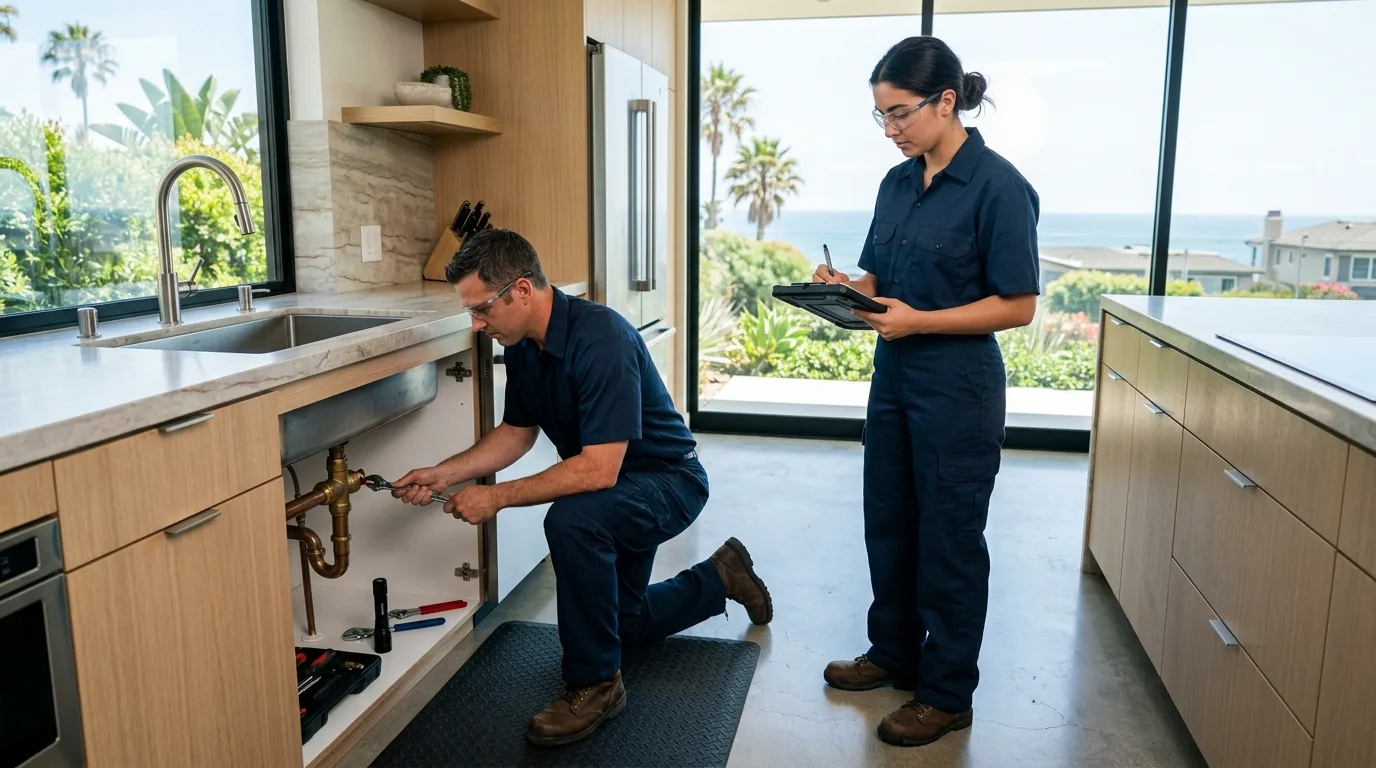
Slab leak repair
Warm floors and unexplained bills in fifty-year-old copper run through concrete.
Adams Avenue, east of Beach Boulevard
The subdivisions either side of Adams went up in the 1960s and 70s on concrete slabs with copper supply. That copper is now old enough that pinholes are routine rather than unlucky.
Adams call: 657-337-7830
Warm spot on the floor, or the meter turning with everything off? Say so when you call.
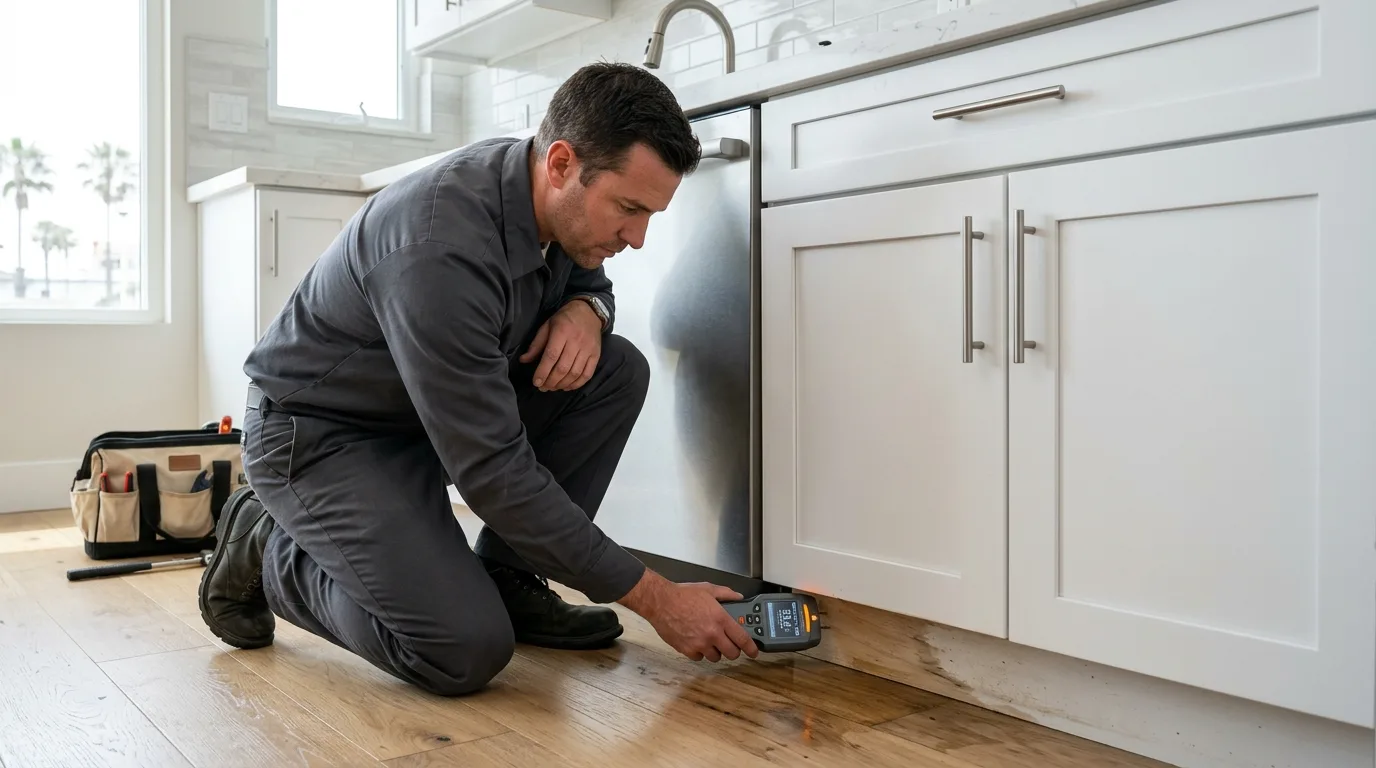
Fifty-year-old copper in concrete. The most common serious call on these streets.
Mature parkway trees and clay laterals is a combination with one predictable outcome.
Reroute one line or replace the system. Both priced, with the reasoning shown.
A central location off Adams means short drive times across the Adams tracts.
On the ground
The neighborhoods flanking Adams Avenue east of Beach Boulevard: running out toward Magnolia, Bushard and Brookhurst: are among the most consistent housing stock in the city: single-story and two-story tracts, concrete slab foundations, attached garages, original copper supply and cast iron or early ABS drainage. Consistent stock means consistent failures, and by now they are arriving on schedule.
Pinholes in slab copper. Soft copper run through and under concrete has spent half a century in contact with a slab, sometimes with poor sleeving, sometimes with a nick from the original pour. Add aggressive imported water and the result is a slab leak: a warm patch on the floor, a hot water line that never seems to stop running, or a water bill that jumped without explanation.
The meter test tells you a lot. Shut every fixture, then watch the meter’s low-flow indicator. If it moves, water is escaping somewhere between the meter and the last valve. That single observation separates a plumbing leak from a landscape or neighbor issue, and it is worth doing before you call.
Clay laterals and parkway trees. These streets were planted at build-out, and those trees are now large. Their roots find the joints in clay sewer laterals, and the line closes slowly: a slow tub first, then a gurgling toilet, then a backup. Cabling opens a channel through the roots; it does not remove the intrusion. A camera inspection tells you whether the pipe is otherwise sound.
Original water heaters in the garage. Garage installations here are frequently on their second or third unit, and the older ones commonly show the same handful of code issues: one strap instead of two, T&P discharge terminating in a bucket or nowhere at all, and no expansion tank on a system that now has a check valve upstream. Those get flagged on any heater visit.
Cast iron reaching the end. Where the original drainage is cast iron rather than ABS, internal scale has narrowed the bore and the bottom of horizontal runs may be thinning. That is a jetting candidate if the pipe is sound and a repair candidate if it is not, and only footage settles which.
The residential blocks north and south of Adams Avenue from Beach Boulevard east to Brookhurst Street, including the tracts around Newland, Magnolia and Bushard and the streets running down toward Yorktown and Indianapolis.
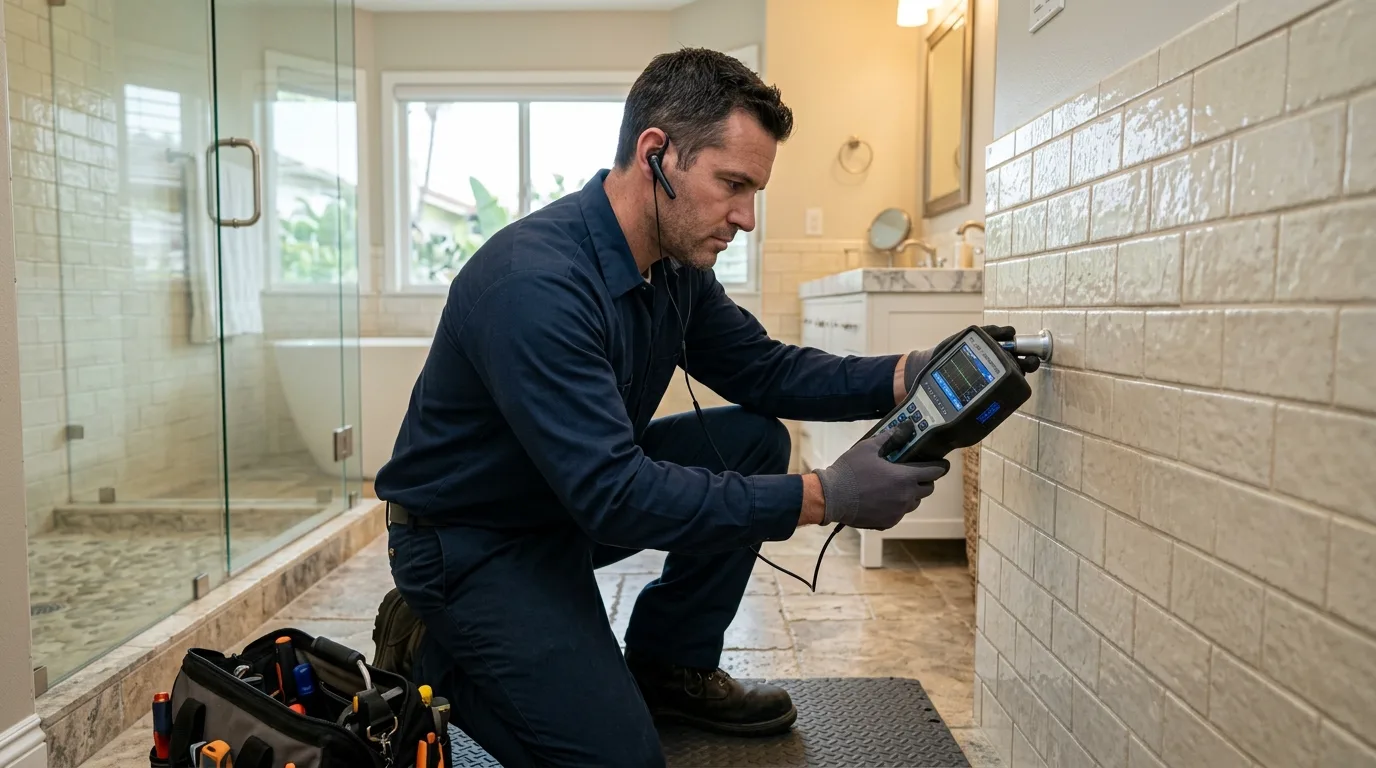
Locating comes before opening concrete, every time. Pressure isolation narrows it to hot or cold. Acoustic listening picks up the escape at the slab surface. Thermal imaging finds the heat plume from a hot line. Tracer gas is the fallback when a line is dry or the noise floor is high.
The point of all four is the same: put the access hole where the leak is, not where it might be. A plumber who wants to start breaking concrete before locating is guessing with your floor, and you are entitled to ask what the locate showed before anyone picks up a saw.
On a first leak in otherwise sound copper, a spot repair through a small access opening is usually the right call. On a second leak in the same system, rerouting that run overhead through the attic often costs less than opening the slab again, and it takes that line out of the concrete permanently.
By the third leak the arithmetic has changed, and a full repipe stops the cycle rather than paying for it in instalments. There is no fixed rule here, only honest numbers: what each option costs, and what each one leaves behind in the slab.
Calling from Adams
Warm floor, running sound, high bill or slow drains, and whether the meter moves with everything off.
Pressure isolation, acoustic and thermal work to fix the position before any concrete is touched.
Spot repair, reroute or repipe, with what each leaves in the slab stated plainly.
Photos and findings recorded, since sudden-escape claims usually need them.
Active leaks under a slab are treated as urgent, not scheduled for next week.
Most requested here
Warm floors and unexplained bills in fifty-year-old copper run through concrete.
Acoustic, thermal and tracer-gas locating so the access hole lands in the right place.
Clay joints opened by mature parkway trees, cabled repeatedly and never resolved.
Third pinhole in the same system, where patching has stopped being economical.
End-of-life tanks brought up to current strapping, venting and discharge standards.
Slow drains and gurgling fixtures cleared, then checked for the reason.
No concrete gets opened on a guess.
Where we send plumbers
Adams runs east from Beach Boulevard toward Brookhurst, with Southeast Huntington Beach below it and Fountain Valley across the boundary.
Straight answers
It is the classic sign of a hot-water line leaking under the slab, and in this housing stock it is the most likely explanation. It is not the only one: a hydronic line or a heating duct can produce warmth too.
Shut the water heater’s cold inlet and see whether the meter stops. That distinguishes a hot-side leak from a cold-side one and saves diagnostic time.
Close the main shutoff at the house side and watch the meter. If it keeps moving with the house isolated, the loss is between the meter and the shutoff, which is a different conversation.
If it stops when the house is isolated but runs when the house is open, the leak is inside your system. Either way the meter answers it in about ten minutes.
No. The purpose of electronic locating is to reduce the opening to a small, specific access point rather than an exploratory trench.
Where flooring is expensive or the leak sits under a kitchen island, rerouting the run overhead avoids opening the slab at all. That option should be priced alongside the repair.
Two leaks in the same original copper is a pattern rather than bad luck, and it usually means the rest of the system is the same age and in the same condition.
Get a repair price and a repipe price at the same visit. Often the second repair plus the third one you have not had yet exceeds doing it once.
It is common on these streets, and it is not something to accept. An annual backup almost always means roots re-entering a clay joint that is still open.
A camera shows how far the intrusion runs and whether the pipe around it is intact. That determines whether the answer is periodic maintenance, a spot repair or a liner.
Policies vary, but many cover the resulting water damage and the cost of accessing the pipe while excluding the pipe repair itself. Long-term seepage is often excluded entirely.
That is why documentation matters: photos, the locate findings and the date discovered. Ask for them, and notify your carrier early rather than after the repair.
Both are code-compliant and both are used routinely in this area. Copper is rigid and proven; PEX is faster to install, needs fewer wall openings and is not subject to the pitting that affects copper in aggressive water.
On an occupied slab home, PEX routed overhead usually means less demolition and a shorter job. The honest answer depends on your house and how long you intend to keep it.
Twelve is past the typical service life of a standard tank, so it is reasonable to plan rather than wait. A planned replacement is a scheduled job; a failed one is an emergency plus flooring.
In a garage, a failure is usually survivable. If yours sits in an interior closet, the case for replacing on your own timetable is stronger.
For an active leak or a backup, usually yes: Adams is central and drive times are short. Dispatch is live around the clock rather than an answering service taking messages.
For planned work like a repipe or a heater swap, we will give you a real window rather than an optimistic one.
Live dispatch, 24 hours a day.
Adams Avenue
Tell us what you are seeing (warm floor, running meter, slow drains) and we will send someone equipped to locate it properly.
Serving every Huntington Beach neighborhood, plus the cities next door.