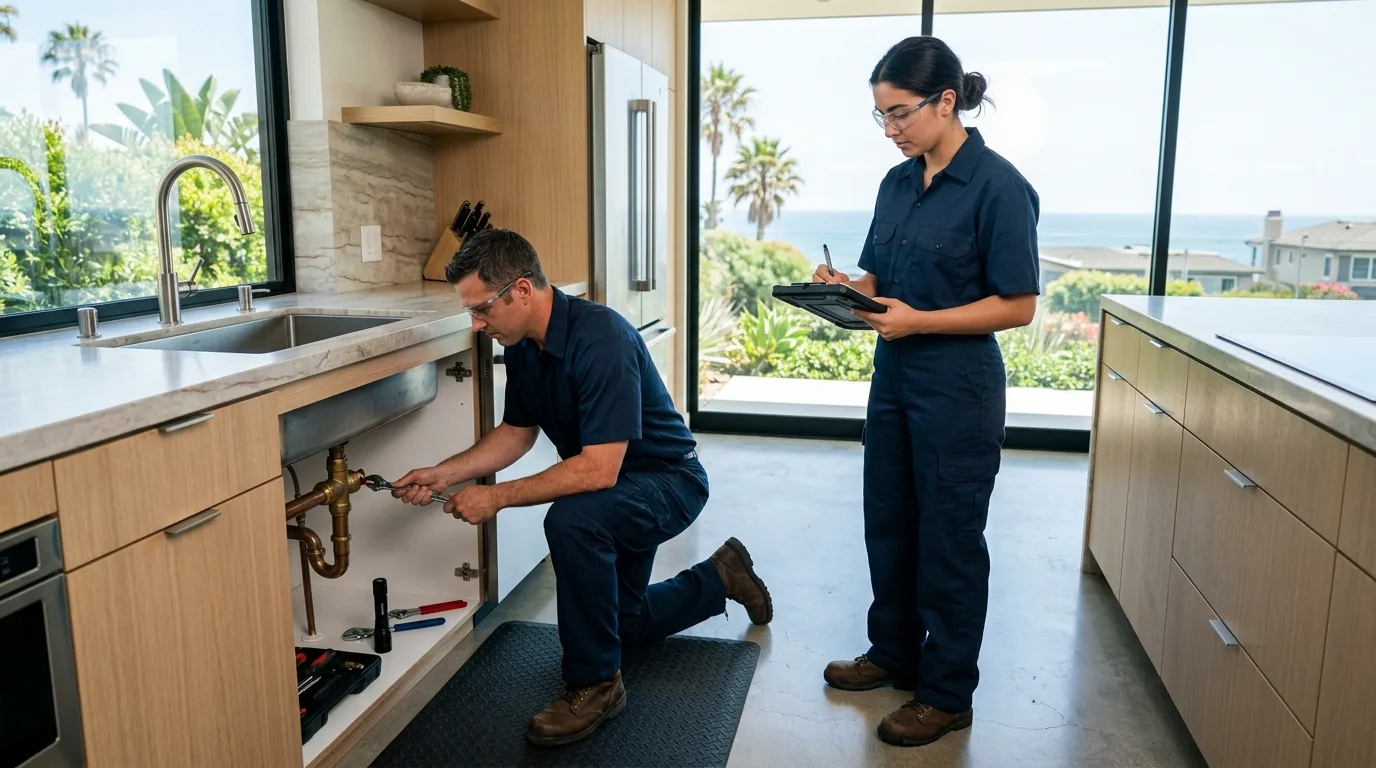
Slab leak detection
Warm floors, spinning meters and bill spikes in postwar concrete-slab tracts.
Below Adams toward Atlanta and Hamilton
The postwar tracts south of Adams are where slab leaks live. Copper poured into concrete decades ago is now at the age where it starts telling you about itself.
South HB call: 657-337-7830
Warm patch on the floor, bill up with no change in habits? Take a meter photo before you call.
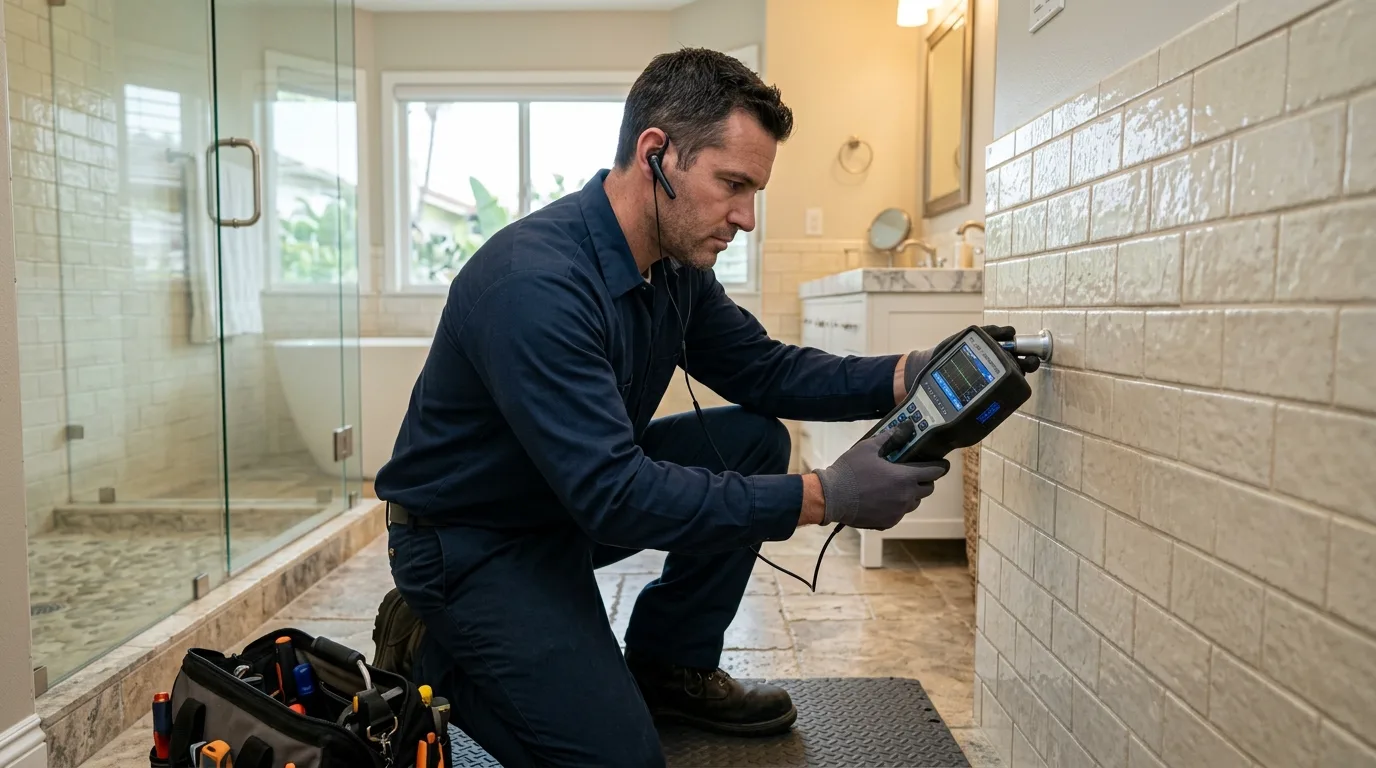
Acoustic and thermal locating narrows an under-slab leak to a spot, not a room.
Two honest options: open the slab at the leak, or abandon the run and reroute overhead.
Deep front-yard setbacks mean long sewer lines with many joints under mature trees.
Nearly universal here, and nearly always due a flush, a strap check and a flue inspection.
On the ground
South Huntington Beach: the tract neighborhoods below Adams running toward Atlanta, Hamilton and the Newland and Magnolia corridors: is dominated by postwar slab-on-grade housing built within a fairly narrow window. That uniformity makes the problems predictable.
Copper under concrete, at the age it fails. These homes ran soft copper under and through the slab, often unsleeved. Decades of concrete contact, soil chemistry, thermal cycling and high water pressure produce pinholes. Hot lines fail first, which is why the warm-spot-on-the-floor call is so common here. Full detail on slab leak repair.
The tells, in order of reliability. A warm patch on tile or carpet. A water meter that moves with everything shut off. A bill that jumped with no change in habits. Faint running water heard at night. Cupping wood or lifting vinyl. New cracks in tile or grout. Hot water that never quite recovers.
Long front-yard laterals. Deep setbacks mean long sewer lines with many joints, and decades-old street trees directly above them. Root intrusion at clay joints is the classic result, and it presents as the whole house backing up into the lowest fixture. Camera diagnosis before any replacement quote is non-negotiable here.
Garage water heaters. Practically universal in these tracts, and practically always overdue. Hard water builds sediment that makes tanks rumble and shortens their life, while older installations frequently have single or missing seismic straps and questionable T&P discharge piping.
Additions and remodels. Many of these homes have grown: second stories, room additions, converted garages. The junctions between original and later plumbing are where a disproportionate share of leaks begin.
The tract neighborhoods below Adams Avenue, running through the Atlanta, Hamilton, Yorktown and Indianapolis cross streets, either side of Newland, Magnolia and Bushard, and down toward the Banning and Brookhurst edges.
Once a slab leak is located, there are two legitimate paths. A spot repair cuts the concrete at the leak, replaces the failed section and restores the floor. It keeps the layout, uses the least new pipe, and suits a home with otherwise sound plumbing where the leak is somewhere reachable. An overhead reroute abandons the run in the slab and runs new pipe through walls and attic to the same fixtures: no jackhammering, and the new pipe stays accessible for good.
Inland here, groundwater is generally less of a complication than it is near the coast, so clean spot repairs are more often practical than they are in the Harbour. But if a house has already had two or three slab leaks, the under-slab copper is telling you about its remaining life, and rerouting the distribution out of the concrete usually costs less than the sequence of repairs that would otherwise follow.
Photograph the water meter, including the low-flow indicator, with everything off. Find your last two or three water bills. Note where the warm spot is and when you first noticed it. That information genuinely shortens the diagnosis and reduces what you pay for locating time.
Calling from South HB
Meter observation and isolation testing confirm water is escaping and narrow it to hot, cold or drain.
Acoustic listening and thermal imaging mark the spot within inches, so only the right concrete is considered.
Spot repair or overhead reroute, with the disruption, duration and cost of each stated plainly.
New pipe pressure tested before anything closes; concrete patched, with flooring flagged as a separate trade.
Bring the bills and the meter photo: both shorten the visit.
Most requested here
Warm floors, spinning meters and bill spikes in postwar concrete-slab tracts.
Isolation testing that regularly identifies a toilet or irrigation valve instead of the slab.
Root intrusion in long front-yard clay lines under mature street trees.
Including strapping, venting and expansion control brought to current code.
Taking distribution out of the slab permanently after repeat leaks.
Whole-house backups presenting at the lowest shower or floor drain.
Warm spot, high bill, running sound: any one is worth a call.
Where we send plumbers
These tracts connect to the Adams and Garfield corridors above, Southeast Huntington Beach and Brookhurst to the east, and the beach-adjacent condo communities to the west.
Straight answers
Photograph your water meter with everything in the house shut off, including the low-flow indicator, and find your last two or three bills.
Then call. Those two pieces of information genuinely shorten the diagnosis, and locating time is what you are paying for on a slab leak visit.
For a spot repair, typically a cut of a few square feet centered on the located leak, plus working room in the excavation below.
Accurate locating is what keeps that small. If the leak sits under cabinets or a tiled shower, an overhead reroute that avoids opening the floor at all is often the better option.
Often, by rerouting the affected line overhead through walls and attic space and abandoning the run in the slab. That trades floor damage for wall and ceiling patches.
Which is better depends on the leak location, the condition of the rest of the plumbing, and how many leaks the house has already had.
On copper of the same age in the same soil carrying the same water, the odds are not favorable. Many homes in these tracts see a second within a few years.
That is the honest argument for rerouting rather than repeatedly patching. Ask the plumber to show you the condition of the section they cut out and decide from the evidence.
Very frequently. A running toilet flapper, an irrigation valve leaking underground, or a pool autofill will all move a meter and inflate a bill.
A competent visit rules those out with isolation testing before anyone opens concrete. If a plumber wants to cut the floor before proving the loss is under it, get a second opinion.
A main line blockage. Everything upstream is looking for somewhere to go and finding the lowest opening in the house.
Stop running water immediately (no laundry, no dishwasher, no flushing) and call. In this neighborhood it is usually roots in a long clay lateral.
Rumbling is sediment on the tank floor, and it is nearly universal on unflushed tanks in this water. A flush often quiets it and restores usable capacity.
If the tank has gone many years without one, flushing can reveal a leak at the drain valve, which a plumber will warn you about first. Past about twelve years with a significant fault, replacement is usually the better value.
Yes. The laterals here are long, often clay, and sit under decades-old street trees, and a standard home inspection does not include them.
A camera inspection before closing is the highest-value inspection add-on available on a home of this age.
At the junctions, yes. Where original plumbing meets later work: different materials, different eras, different installers: a disproportionate share of failures begin.
A plumber familiar with these tracts checks the transition points first, which is often why they find things faster.
Two real methods, honest trade-offs, no push toward the bigger one.
South Huntington Beach
Warm floor, high bill or a meter that will not stop? Tell us what you have noticed and we will send someone who locates these weekly.
Serving every Huntington Beach neighborhood, plus the cities next door.